
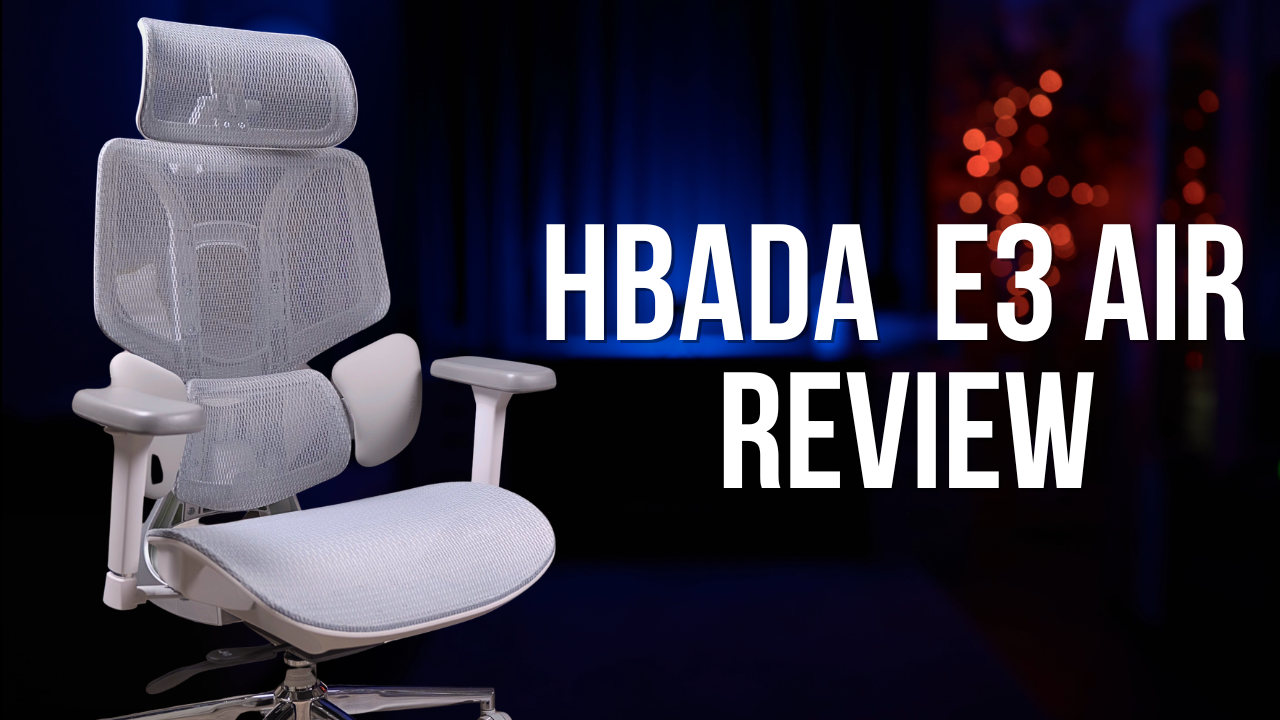
The Hbada E3 Air is the most budget-friendly option in Hbada’s E3 chair lineup, coming in at around $400. That’s significantly cheaper than its siblings – the E3 Pro at $550 and the E3 Ultra at $700. After spending several weeks testing this chair, I’ve found something interesting: despite being the most affordable model in the lineup, the E3 Air might actually be the best value of them all. It offers most of what you’ll get from the higher-end models at a much lower price point.
In this review, I’ll cover everything you need to know about the Hbada E3 Air including materials and build quality, adjustability, comfort, and overall value to help you decide if this chair is the right fit for your needs.
Note: While Hbada provided this chair for review purposes, all opinions expressed here are entirely my own.
Design Overview
The Hbada E3 Air features a clean, all-mesh construction with a modern aesthetic that would comfortably fit in most office settings. One of the most unique design elements is the adjustable side flaps on the backrest, which can be folded inward to create a hugging effect around your lower back—a distinctive feature I haven’t seen on many other chairs.
All-mesh chairs tend to look fairly similar, but I think Hbada has done an excellent job with its E3 series, giving it unique features that help it stand out from competitors.
Build Quality and Materials
For a chair at this price point, the E3 Air’s build quality is impressive. It features a metal base, though it is a 6-piece base that requires assembly rather than the single-piece construction you’d find on premium chairs.
The mesh is a plastic-like material similar to what you’ll find on most all-mesh office chairs. It has good elasticity and feels supportive, though it isn’t the softest and can feel a bit scratchy at times.
What’s particularly noteworthy is that the overall component quality is nearly identical to the more expensive E3 Pro. While the Pro may offer a few additional features, the actual materials and build quality are essentially the same between the two, making the Air an excellent value proposition.
The chair feels sturdy with components that fit together well. In my two weeks of testing, I haven’t noticed any creaking or wobbling. With a 300lb weight capacity and a 3-year warranty, the durability seems appropriate for the price point.
Comfort Breakdown
Seat Comfort
Mesh seats can be polarizing – they’re difficult to execute well, even for high-end chairs. That said, the E3 Air has one of the most comfortable mesh seats I’ve used, regardless of price.
The high-elastic mesh material has excellent tension – not too loose and not too firm. It’s comfortable to sit in and doesn’t sag or bottom out, while avoiding the overly rigid feel common in many mesh chairs.
One standout feature is Hbada’s decision to move away from using a foam pad at the front of the seat. Most mesh chairs include this foam pad to provide cushioning where your legs contact the frame, but this often creates a problematic creasing effect when sitting. As you sink into the mesh, the foam pad can dig uncomfortably into the backs of your thighs.
Higher-end chairs like the Herman Miller Aeron Remastered and Ergohuman Gen 2 have moved away from this foam pad design, so it’s impressive to see Hbada implementing this improvement in a much more affordable chair.
The E3 Air also features an excellent waterfall edge design that avoids common mesh seat problems, plus a seat depth adjustment to accommodate different leg lengths.
One limitation to note: if you prefer sitting cross-legged or with one leg tucked under, this chair won’t accommodate those positions well. Like all mesh chairs, the rigid frame needed to support the mesh will dig into your ankles in these positions.
Backrest
The E3 Air has one of the most unique backrests I’ve encountered. It offers independent height adjustment for both the upper back and lumbar support – something I’ve never seen before. Typically, chairs with height adjustment move the entire backrest as a single unit.
This independent adjustment system allows you to position the lumbar support precisely where you need it while separately adjusting the upper backrest based on your height and shoulder position – a remarkable level of customization at this price point.
The lumbar support itself is pronounced without feeling pokey, thanks to its mesh construction. It offers good front-to-back and side-to-side movement, adapting to your body as you shift positions. This adaptive design solves a common problem with split-back mesh chairs: many push you too far forward, preventing contact between your upper back and the upper portion of the backrest. The E3 Air’s flexible lumbar support allows you to fully engage with the entire backrest.
The folding side flaps on the lumbar support are a unique feature. When folded inward, they wrap around your waist for a hugging sensation. While I personally prefer keeping the flaps open to avoid feeling constricted, some users might enjoy this feature. Even with the flaps fully extended, the foam padding (wrapped in faux leather) provides a gentle embracing effect.
The mesh itself has excellent elasticity, preventing you from feeling the frame underneath while providing good support. While it can feel somewhat coarse against bare skin, this is rarely an issue during normal use.
Recline Function
The E3 Air offers a deep 140-degree recline and allows you to lock the chair in a reclined position, which is perfect for lounging. The recline motion is smooth, thanks to what Hbada calls their “auto gravity sensing mechanism” – essentially a weight-activated mechanism that automatically adjusts recline tension based on your body weight.
While the motion is smooth, I found the recline tension too loose with no way to adjust it. What I typically look for is a chair that can hold me in a partially reclined position without locking – giving that floating feeling where you’re perfectly balanced. Unfortunately, the E3 Air requires some initial force to recline, but once you pass a certain point, it reclines fully with no intermediate stopping points.
This weight-activated system will provide inconsistent experiences depending on user weight and body type. While it simplifies use for those unfamiliar with chair adjustments, I personally prefer having manual control over recline tension.
Headrest
The headrest on the E3 Air is excellent. It offers 3D adjustability with height and two pivot points. The adjustment ranges are generous enough to accommodate taller users and allow comfortable positioning whether sitting upright or reclined.
The pivot adjustment features an arcing motion that moves forward and down, effectively providing depth adjustment so the headrest remains useful even when sitting forward in the chair. You can also move it completely out of the way when not needed.
Position retention is excellent. The pivot adjustment uses a rear knob for tightening, and while you can’t easily reach this while seated, I found leaving it fully tightened still allows sufficient adjustment while preventing unwanted movement.
Using the same mesh as the rest of the chair creates a cohesive look. The headrest is wide enough to prevent contact with the hard frame edges. The mesh can feel somewhat coarse against the neck, and occasionally I noticed it tugging slightly on my hair, but only when making significant movements while firmly resting on it.
Armrests
The E3 Air comes with 3D-adjustable armrests offering height, depth, and pivot adjustments. While they lack width adjustment, the available adjustments should work well for most users.
The arm pads have comfortable rounded edges that won’t dig into your arms and maintain a flat top surface to prevent slipping. They offer decent softness, allowing you to rest your elbows without discomfort.
While not as sophisticated as the armrests on the Pro and Ultra models, they’re perfectly functional and comfortable for everyday use.
Value and Policies
Priced at around $400, the Hbada E3 Air offers exceptional value. You get good build quality, a comfortable sitting experience, and unique adjustment features rarely found at this price point.
What’s particularly impressive is how similar it is to the more expensive Pro and Ultra models in terms of core comfort and build quality. You’re primarily missing some extra features rather than any fundamental quality difference.
Hbada offers a 3-year warranty and 30-day money-back guarantee. While appropriate for a $400 chair, this same warranty applies to their $700 Ultra model, making the E3 Air much better positioned from a value perspective. Once you start spending $500-700 on a chair, you’re competing with major brands offering 10-12 year warranties.
Conclusion
The Hbada E3 Air might be the best all-mesh office chair under $500 I’ve tested. Its seat comfort is exceptional for a mesh design, and the unique adjustability features help it stand out from the competition.
If you’re looking for an all-mesh chair that offers excellent comfort, good build quality, and unique ergonomic features without breaking the bank, the E3 Air deserves serious consideration. It delivers a premium sitting experience at a mid-range price, making it not just the best value in Hbada’s lineup, but possibly one of the best values in the all-mesh chair market.
Pros:
- Exceptional mesh seat comfort
- Unique independent adjustment for upper back and lumbar
- Excellent headrest design
- Good build quality
- Great value at $400
Cons:
- No manual control for recline tension
- Mesh can feel somewhat coarse
- No width adjustment for armrests
Final Verdict: 4.5/5 ★★★★½
[Link to purchase the Hbada E3 Air]