
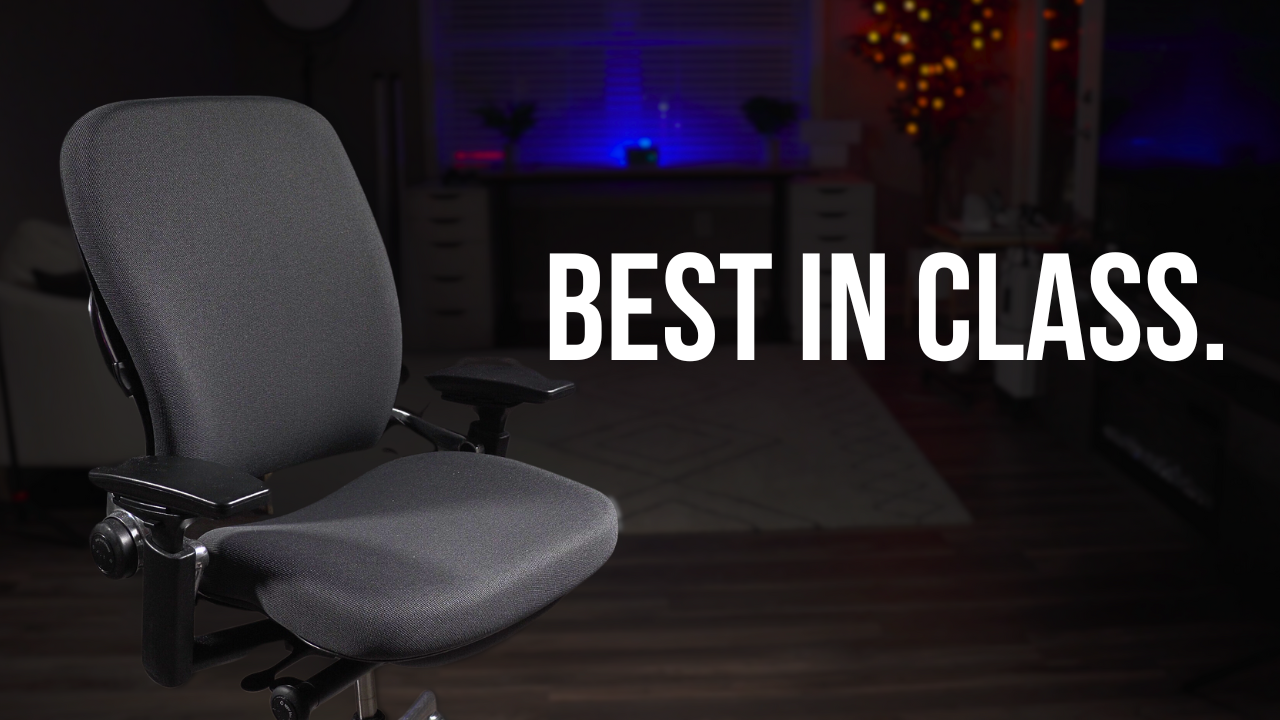
The Steelcase Leap v2 is one of the most popular high-end office chairs on the market, and for good reason. As Steelcase’s flagship model, it combines sophisticated ergonomics with exceptional build quality. But with a price tag starting around $1,300, it represents a significant investment. Is it worth the premium?
After extensively testing the Leap v2 and comparing it to dozens of other office chairs across various price points, I’m ready to give you my full assessment. This review will examine its design, build quality, comfort, adjustability, and overall value to help you decide if this chair deserves a place in your workspace.
Steelcase Leap V2 Video Review
Design Overview
Aesthetics
The Leap has a relatively understated design compared to other flagship chairs from competitors like Herman Miller or Haworth. It features clean lines and a minimalist appearance that leans more toward function than fashion.
This simpler design philosophy runs throughout Steelcase’s lineup. It’s not necessarily a drawback – the understated look allows the Leap to blend seamlessly into virtually any office or gaming setup without looking out of place or drawing too much attention.
Steelcase offers numerous color and upholstery options, allowing you to customize the chair to match your specific setup. Whether you prefer something conservative for a corporate environment or something more vibrant for a home office, there’s likely a configuration that will work for you.
Materials and Build Quality
When it comes to build quality, the Steelcase Leap is exceptional. Steelcase chairs are known for their durability, and the Leap certainly lives up to this reputation.
To put this into perspective, my first Leap was a used model manufactured in 2007 that I purchased on eBay. Despite being over 15 years old at the time, it was still in pristine working condition – a testament to how well these chairs are built.
The frame is primarily plastic, which might surprise some people expecting more metal in a premium chair. However, this is an intentional design choice rather than a cost-cutting measure. The high-density plastic allows for flexibility and promotes movement while you sit, which is central to the chair’s ergonomic philosophy.
This plastic construction doesn’t compromise durability in any way. The Leap has a 400-lb weight capacity, demonstrating the robustness of its construction. These chairs are built like tanks and designed to last for decades, not just years.
Adjustability
The Leap v2 offers impressive adjustability options that allow you to customize the chair to your specific body and preferences:
- Seat height adjustment: Standard pneumatic adjustment with a good range suitable for most users
- Seat depth adjustment: Allows you to slide the seat forward or backward to accommodate different leg lengths
- Lumbar height and firmness: Adjustable lumbar support with both height adjustment and a firmness control knob
- Tilt limiter: Five different backstop positions to control how far back you can recline
- Tilt tension: A knob to control how much resistance you feel when reclining
- 4D armrests: Height, width, depth, and pivot adjustments for the armrests
All these adjustment mechanisms are thoughtfully placed and easy to access while sitting in the chair. This makes fine-tuning your sitting experience much more convenient compared to chairs where you need to stand up to make adjustments.
Comfort Breakdown
Backrest Comfort
The backrest is unquestionably the Leap’s strongest feature. It offers one of the most comfortable and supportive sitting experiences I’ve found in any office chair.
The key to this comfort is what Steelcase calls their LiveBack technology. The backrest is designed to flex and contour to your spine’s natural movements, providing consistent support as you shift positions throughout the day.
You can actually feel the backrest adapting to your movements, maintaining proper support whether you’re sitting upright, leaning to one side, or stretching. This dynamic support helps reduce fatigue during long sitting sessions.
The entire backrest is padded, which means you won’t feel any hard frame edges even when shifting positions – an issue common with mesh-back chairs.
The Leap’s lumbar support is fully adjustable in both height and depth (or firmness). You can easily adjust the height by grabbing the tabs on each side and sliding up or down. The depth adjustment knob on the side allows you to increase or decrease how pronounced the lumbar support feels.
I’d describe the lumbar support as fairly prominent, especially at higher firmness settings. If you prefer aggressive lower back support, you’ll likely appreciate the Leap’s approach. However, if you find it too aggressive, you can actually remove the lumbar support entirely. Even without it, the backrest’s natural curve provides good support.
One area where the Leap isn’t perfect is its recline mechanism. While functional, it doesn’t feel as smooth as what you’ll find on some Herman Miller or Haworth chairs. When reclining, you can feel some friction in the mechanism, which makes it less ideal for rocking motions.
Also, the maximum recline doesn’t go back quite as far as I’d prefer for lounging. It’s sufficient for periodic stretching and position changes, but not ideal if you frequently switch between intensive work and more relaxed postures.
Despite these minor criticisms, the Leap’s backrest is still among the best I’ve experienced. It excels at providing dynamic support throughout the day, which makes it excellent for preventing and alleviating back pain during long work sessions.
Seat Comfort
The Leap’s seat is one of my favorites among high-end office chairs. It provides a traditional sitting experience that most people will find familiar and comfortable, even if they’re not used to ergonomic chairs.
The seat uses high-density foam padding that strikes an excellent balance between support and cushioning. It’s firm enough to maintain proper posture but has enough give to remain comfortable during extended sitting. This balance helps prevent both discomfort from too-soft cushioning and pressure points from overly firm seats.
Perhaps the most distinctive feature of the Leap’s seat is the flexible seat edge. As you move in the chair, the entire front portion of the seat flexes considerably. This design reduces pressure on the back of your thighs, promoting better circulation and preventing the uncomfortable numbness that can develop during long sitting sessions.
While the seat is excellent overall, it’s not perfect. The foam padding is relatively thin, and though it’s high-quality enough to prevent bottoming out, some users might find it a bit too firm. Additionally, the contoured shape of the seat can create the sensation of insufficient padding around the tailbone area, which is a common complaint among users.
This issue seems to stem from the seat’s contoured shape rather than the foam padding itself. The Leap’s seat curves down slightly in the center, creating a cradling effect that some users love but others find problematic. In comparison, Steelcase’s Amia chair uses a flatter seat shape with similar padding thickness and tends to distribute weight more evenly, resulting in fewer complaints about tailbone pressure.
Despite these potential drawbacks, the Leap’s seat remains very comfortable for most users. The flexible front edge is a standout feature that significantly enhances comfort during long sessions.
Armrests
The Leap’s armrests are among the best I’ve used on any office chair. They offer full 4D adjustability with height, width, depth, and pivot adjustments.
The range of motion is excellent, allowing you to position the arms precisely where you need them. They also go low enough that you can push them completely out of the way when not needed – useful for guitar players or anyone who occasionally needs unobstructed movement.
The arm pads themselves have a good amount of softness that makes them comfortable even when leaning heavily on your elbows. The shape is well-considered and doesn’t dig into your arms.
One minor issue is that the armrests can wobble slightly when raised to their maximum height. This typically isn’t noticeable during normal use but might bother those who are particularly sensitive to movement. Additionally, apart from the height adjustment, the other adjustments don’t lock firmly into place. They use smooth sliding mechanisms that can occasionally be bumped out of position.
Despite these small concerns, the Leap’s armrests provide excellent support and adjustability that enhances the overall comfort of the chair.
Headrest (Optional)
The optional headrest for the Leap v2 is, unfortunately, one of its weakest features. At approximately $200, this add-on is expensive, yet the quality doesn’t match the rest of the chair.
The headrest lacks the adjustability you’d expect at this price point, offering only height adjustment without depth or pivot options. More problematically, it doesn’t maintain its position well, often sliding down when pressure is applied.
Since the angle can’t be adjusted, the headrest tends to push your head forward uncomfortably, and there’s no way to move it out of the way when not needed. Once installed, it’s not designed to be removable.
My recommendation: skip the headrest. If you specifically need head support, consider the Steelcase Gesture with its superior headrest design, or look at other brands with better headrest implementations.
Value and Warranty
There’s no getting around it – the Steelcase Leap v2 is an expensive chair, starting at around $1,300 for the base configuration. Depending on your customization choices, the price can climb considerably higher.
But what are you getting for your money? First and foremost, exceptional build quality and durability. The Leap is designed to last for well over a decade of daily use. Steelcase backs this up with one of the best warranties in the industry: 12 years of comprehensive coverage that includes virtually all components.
This warranty reflects the chair’s expected lifespan. Many users report their Leap chairs functioning perfectly after 15+ years of regular use. When you consider the cost amortized over this extended lifespan, the value proposition becomes more apparent.
For those who find the new price prohibitive, the Leap’s popularity means there are plenty of used and refurbished options available at significantly lower prices. Due to the chair’s durability, even a several-year-old Leap is likely to have many years of life remaining.
Pros and Cons
Pros
- Exceptional build quality with proven durability over decades
- Outstanding backrest with dynamic support for various positions
- Flexible seat edge that promotes circulation and prevents discomfort
- Excellent 4D armrests with good range and comfort
- Comprehensive adjustability to fit diverse body types
- Industry-leading 12-year warranty
Cons
- Premium price point that may be prohibitive for some budgets
- Recline mechanism isn’t as smooth as some competitors
- Contoured seat shape may create pressure points for some users
- Poor optional headrest that doesn’t match the quality of the chair
- Understated design might disappoint those seeking a more distinctive aesthetic
Conclusion
The Steelcase Leap v2 remains one of the best office chairs on the market, particularly for those prioritizing back support, adjustability, and long-term durability. Its thoughtful ergonomic design and exceptional build quality justify much of its premium price, especially when considered as a long-term investment in your comfort and health.
Is it worth $1,300+? If you spend several hours daily at your desk and plan to use the chair for many years, the answer is likely yes. The Leap’s ability to maintain comfort during extended sessions while promoting movement and proper posture makes it an excellent choice for professionals, remote workers, and anyone concerned about ergonomics.
However, if you’re on a tighter budget, consider looking at the used market for the Leap or exploring Steelcase’s other offerings like the Amia, which shares many of the Leap’s qualities at a lower price point.
Final Verdict: 4.5/5 ★★★★½
For those who can afford the investment, the Steelcase Leap v2 delivers exceptional comfort, support, and durability that will serve you well for many years to come.
[Link to purchase the Steelcase Leap v2]